
Ascension Parish Release Meanings
A release entry answers one narrow question: when did a specific custodian stop holding the person under that booking? It does not always mean the person walked free. Ascension Parish Jail may release someone after bond, a court order, time served, sentence completion, or dismissal when no other hold remains. The jail may also record an exit when Louisiana DPS&C, another parish, a federal agency, or ICE takes custody. That last group consists of transfers, not community releases.
The Ascension Parish Sheriff’s Office, or APSO, keeps the main local booking source. Its New World inquiry can retain prior booking episodes after active custody ends. A subject page may show an actual release date and time, scheduled date, charge disposition, bonds, court docket, and housing. Read those fields together. “In Custody: No” supports that one APSO episode ended, but a transfer entry controls over any guess that the person returned home.
- Discharge
- The end of a custody or sentence status recorded by the agency that owns it.
- Time served
- A court disposition giving credit for confinement already completed; another hold can still prevent release.
- Parole
- Conditional release from incarceration before the full sentence ends.
- Detainer
- A request or hold that can send the person to another authority instead of the community.
Ascension Parish Release Routes
Each route leaves a different paper trail. Bond and recognizance often point to a court minute plus the APSO booking detail. State pickup shifts the search to Louisiana DPS&C. A person who completes a jail sentence may have both a custody-ending time and a court entry showing satisfaction or credit for time served. No single status should be stretched past what its agency reports.
| Route | What it means | Next record to check |
|---|---|---|
| Cash, surety, or property bond | Pretrial community release, not dismissal | APSO bond fields and the court minute |
| Recognizance or court order | Court-authorized release without proof the case ended | Charge disposition and docket |
| Time served or sentence completion | Confinement may end if no other hold exists | Release timestamp and sentencing record |
| Parole or diminution | Physical custody ends while a sentence status may remain | LAVNS, DPS&C locator, and assigned supervision office |
| Transfer or detainer pickup | Custody continues under another agency | Receiving state, federal, parish, or ICE locator |
| Dismissal | A charge ended, but other charges or holds may remain | All charge rows and the court record |
The jail’s own release procedure and local bond types appear on the APSO Corrections Division page. The official page is useful for identifying the route, but the record for the individual still decides what happened in that case.
Ascension Parish Release Record Fields
Ascension Parish has no single document titled as a universal release record. The closest online source is the retained APSO subject and booking detail. Its strength is the link between identity, booking history, actual jail-exit data, bond, charges, and court information. A booking should be selected by number and date before any old release field is treated as current.
| Field | What it shows |
|---|---|
| Subject and booking number | Which person and custody episode the record describes |
| Booking date and origin | When and how that episode entered APSO custody |
| In Custody | Whether APSO reports the selected booking as active |
| Actual Release Date | When physical custody under that booking ended |
| Scheduled Release Date | A planned date that may change and is not proof of departure |
| Housing facility | Main jail or Off Site Housing category |
| Bond and charge disposition | Possible legal mechanism and outcome for each charge |
| Court docket | The case identifier used to check the court’s legal record |
| Receiving agency | Whether an exit was a transfer rather than community release |
The official APSO historical-detail example shows why the combination matters.
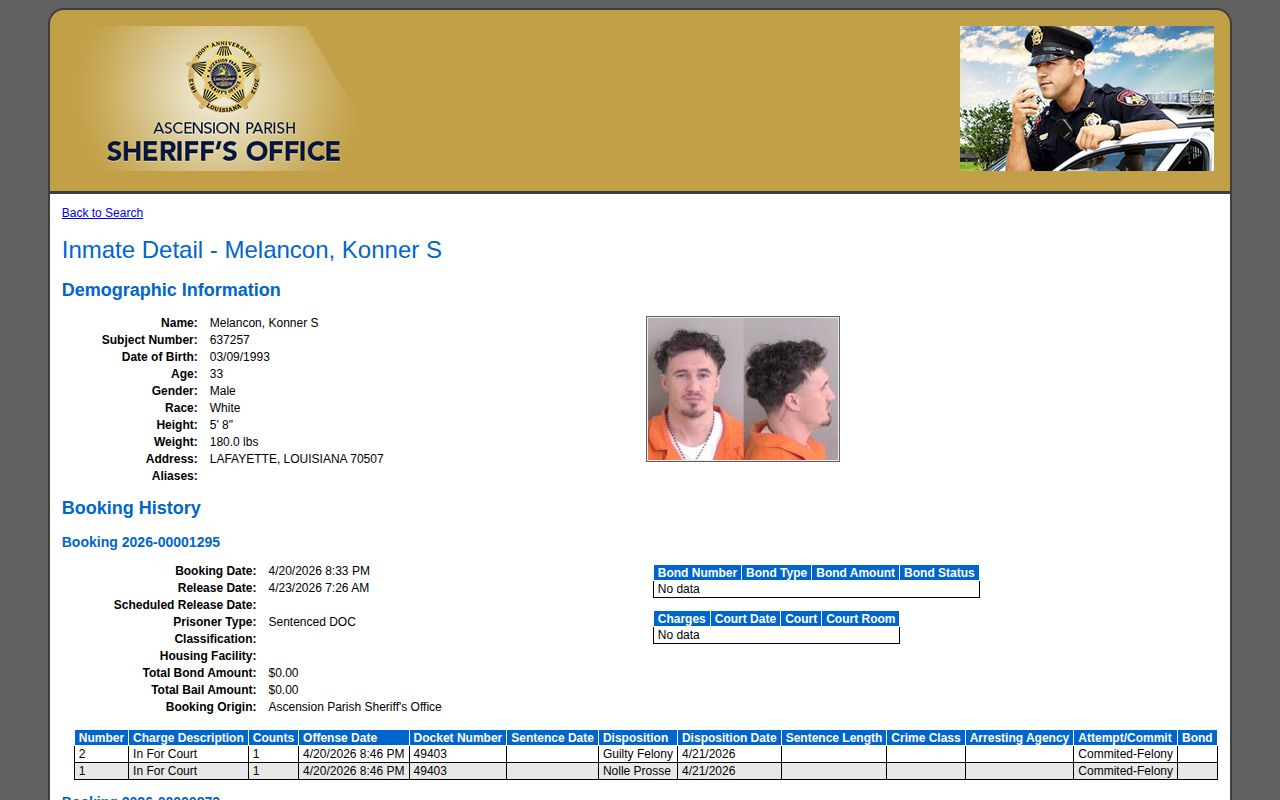
A release time can mark a transfer to another agency, so the disposition and receiving custodian must be checked before calling it a community release.
Request Ascension Parish Release Records
When the public detail is missing or unclear, request the source record. APSO requires a public-records request to be written and sent by USPS. A request delivered another way is not deemed received under the sheriff’s posted process. Address it to Ascension Parish Sheriff’s Office Headquarters, 828 South Irma Boulevard, Gonzales, LA 70737, Attn: Deputy Kyle Gautreau, Legal Affairs. Booking sheets may also be obtained in person at the offices listed by APSO.
- Identify the person, booking number, and booking date as closely as possible.
- Ask for the booking sheet, photograph, movement or release line, actual exit date and time, disposition code, and receiving agency or person.
- Ask APSO to provide separable public portions if protected material must be withheld.
- Mail the request through USPS and keep a dated copy.
- Review the invoice after a disclosure decision, then pay before production using a method APSO accepts.
APSO posts charges of $1 per document page, $5 per photograph page, and $1 per audio or video minute plus $10 per disc. Cost depends on the responsive material. Louisiana R.S. 44:35 concerns a written determination or reasonable-time estimate after five days excluding weekends and legal holidays; it does not guarantee full production in five business days.
The APSO public-records instructions control current delivery rules, exemptions, fees, and payment methods.
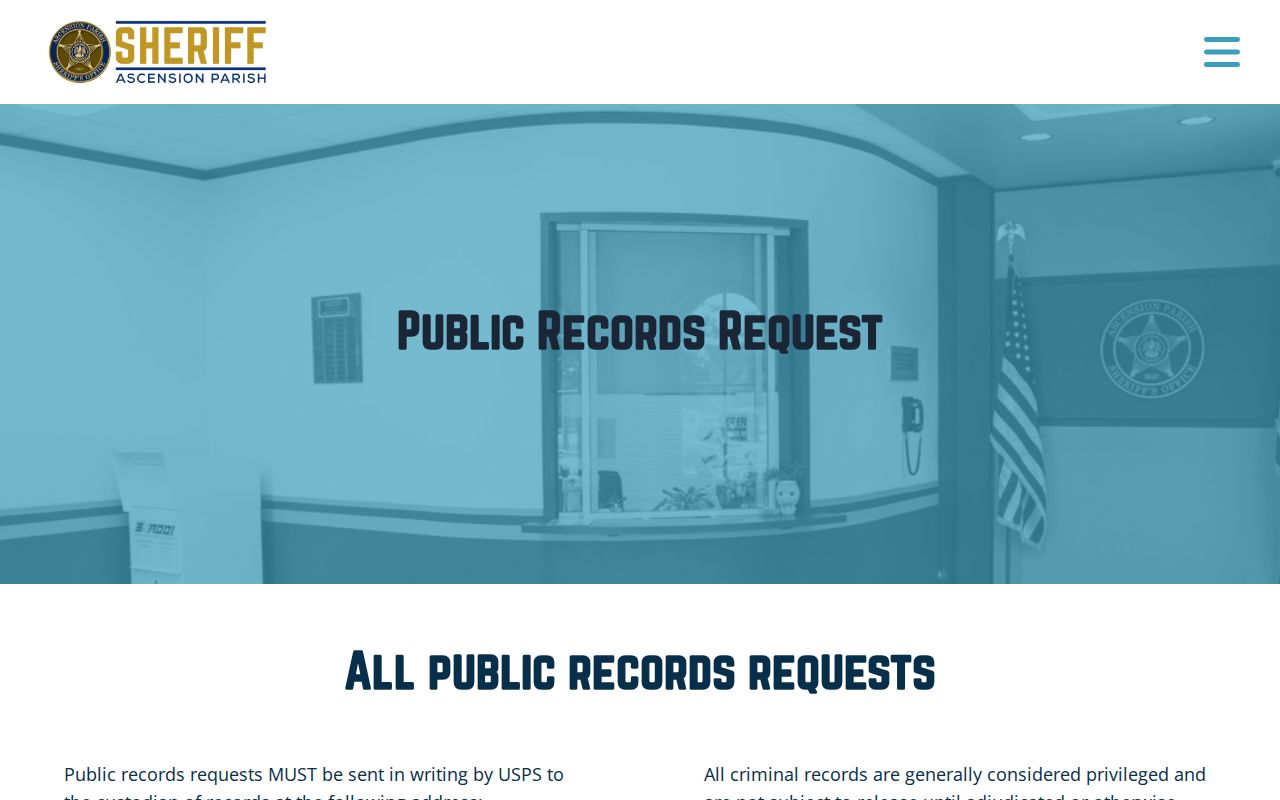
This official request route is the strongest fallback when a live search cannot explain whether an Ascension Parish jail exit was release or transfer.
Ascension Parish Release Record Law
Louisiana’s public-record framework supports access but preserves specific limits. R.S. 44:1 broadly defines public records. R.S. 44:3 protects some law-enforcement and investigative material while recognizing public portions, including booking records described in Code of Criminal Procedure article 228. That article makes the booking book and booking-information summaries open for public inspection and names basic fields such as the booking time, charge, property taken, arresting officer, and event summary.
Juvenile information, victim identities in protected cases, active investigative facts, sealed material, and expunged records may not be public. APSO also warns that criminal records may remain privileged until adjudicated or otherwise settled. A focused request for booking and release lines is more likely to isolate the useful public facts than a demand for the full investigative file.
Ascension Parish Bond Release Proof
APSO identifies cash, surety, and property bonds posted through the sheriff within the 23rd Judicial District Court system. Bond answers how a person gained pretrial release. It does not answer whether the charge was later dismissed, reduced, tried, or resolved by plea. Read the APSO bond row and actual release time next to the relevant court minute.
Cash bond uses funds posted under the court process. A surety bond involves an authorized surety, while a property bond relies on approved property value. The individual record controls whether a bond was posted and whether another charge or detainer blocked departure. A listed amount alone is not proof of payment, and a zero or blank amount cannot supply a release reason the system does not display.
Does bond mean the case is over? No. It is a release mechanism before final disposition. The court docket remains the source for what happened to the charge.
Ascension Parish Release Court Paths
Ascension Parish has two court paths that can explain a jail exit. The 23rd Judicial District Court handles broad criminal jurisdiction. Ascension Parish Court handles qualifying misdemeanors and ordinance matters and has bail and discharge authority within its sphere. Use the docket and court label on the APSO charge instead of assuming every case belongs to the district court.
The clerk’s online ACCESS system adds a language trap. Its phrase “released records” means documents that have been indexed, verified, and released for public viewing. It does not identify inmates released from custody. The Ascension Clerk disclaimer also says the online index is not the official record. Court entries at the clerk’s office remain the official source.
A minute entry can show bond, dismissal, plea, sentence, credit for time served, probation, revocation, commitment, satisfaction, or expungement. The jail timestamp reports when APSO custody ended. The minute explains the court action. Keep both sources in their proper roles.
Ascension Parish Expunged Release Records
Ascension Clerk instructions require a separate motion for each arrest date. The published allocation lists payments to the Bureau of Criminal Identification, district attorney, sheriff, and clerk, with an additional state motor-vehicle payment in qualifying DWI matters. Current eligibility, waivers, totals, and filing requirements must be confirmed before filing.
Expungement can remove covered arrest, case, fingerprint, and booking-photo material from public access without always destroying every agency record. It therefore changes what a public search returns. A missing old APSO result after an order does not establish that no booking or release once took place. The order and the clerk’s official record explain the change better than a blank web search.
Retention is also unknown. APSO supports older booking-date searches and multiple booking histories, but it publishes no guaranteed archive term. Save the booking number and seek an official copy when the record must be durable.
Find Ascension Parish Released Inmates
Start with the system that held the person. APSO covers local jail custody. Louisiana DPS&C covers state sentences, including some state prisoners housed in parish jails. BOP covers sentenced federal imprisonment, while ICE maintains a current civil detention locator. A current roster is only a starting point because released people often leave the default active view.
- Open the APSO Inmate Search. Try full name, separate name parts, subject number, booking number, and known aliases.
- Use In Custody and broad booking dates carefully. Booking From and Booking To filter entry dates, not release dates. Search both Ascension Parish Jail and Off Site Housing.
- Open the correct booking episode. Record the actual release time separately from any scheduled date, then read every bond, charge disposition, and transfer note.
- Check the matching court docket. A compatible bond, dismissal, time-served, or satisfaction entry can explain a community exit.
- For a state sentence, use LAVNS and the DPS&C locator line. For federal or immigration handoffs, use the custodian-specific locator.
- If the path remains unclear, mail a narrow APSO request for the nonexempt movement and release fields.
For a short interval rather than one named person, the Released Last 24 Hours page explains why APSO’s booking-date filters cannot safely create an official release feed.
Ascension Parish State Release Search
Louisiana DPS&C directs the public to LAVNS and VINELink. The state says LAVNS updates every 24 hours and covers imprisoned people plus people under probation or parole supervision. That community-supervision coverage is vital after a prison release. It is not a record of every Ascension Parish arrestee who bonded out before any state sentence.
The public application supports person searches by the identifiers it offers. Match the state, name, ID or case number, agency, birth details, custody status, and location. The precise live labels can change. Capture the exact returned wording rather than translating “community supervision,” “released,” or “out of custody” into a broader claim.
The DPS&C Locate a Person page also gives 225-383-4580. A caller supplies the DPS&C number, or the name and date of birth. The automated locator can return housing assignment, facility contact details, an assigned supervision district, and a projected release date when applicable. The Master Prison Record is the fuller source for sentence calculation.
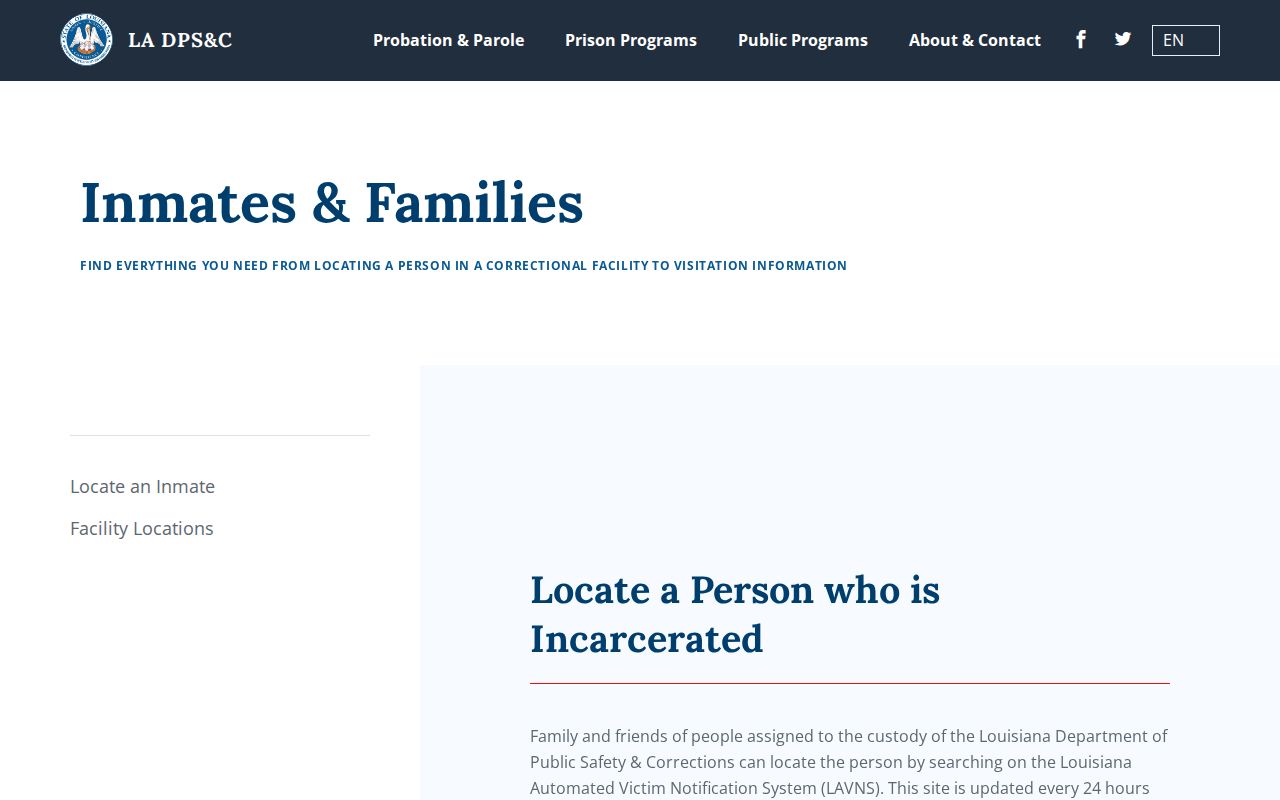
This state route follows a DPS&C case beyond a prison gate, while the APSO detail remains the source for the end of an Ascension Parish jail booking.
Ascension Parish Release Status Sources
Choose the source by custodian and event. A date or status from one system cannot settle what happened in every other system. The table keeps local, state, federal, and immigration paths separate.
| Situation | Best source | What it can establish |
|---|---|---|
| Current Ascension Parish jail custody | APSO inquiry and local LAVNS roster | Reported local housing and active status |
| Prior Ascension Parish booking | APSO subject detail, court docket, or records request | Actual exit time and whether the record names a transfer |
| State prison or state sentence | LAVNS, DPS&C phone locator, Master Prison Record | State custody, projected date, discharge, or supervision |
| Federal imprisonment | BOP Inmate Locator | Past or projected BOP date and whether BOP still holds the person |
| Immigration detention | ICE Online Detainee Locator | Covered current ICE or qualifying CBP custody |
VINELink can send a release or transfer notice for Ascension Parish Jail and Louisiana state prisons. It does not cover BOP or ICE. A VINE message is useful evidence of a reported event, but APSO, DPS&C, or the court should confirm an urgent or disputed result.
“Released” in the BOP locator means BOP no longer has custody. An ICE no-match is weaker because the immigration locator is not a durable release archive. Neither status rules out supervision or custody under another government.
The local LAVNS roster is most useful before an expected Ascension Parish release because a person still listed can be selected for a custody-change notice. Statewide LAVNS reaches both parish jails and state prisons. A notification should be saved with its time and event label. “Transfer” and “release” are not interchangeable, and a no-match does not supply either result. For a state-sentenced person, a shift from an institution to a probation or parole district supports release from incarceration into community supervision. It does not show that the full sentence has expired.
Court and registry sources answer other questions. A court docket may outlast the brief jail entry and explain bond, dismissal, sentence, time served, probation, or revocation. The Louisiana sex-offender registry applies only when a person has a statutory registration duty. Presence there reflects a registration status, not a jail release date or proof of current freedom from all custody.
Ascension Parish Release Facility Context
APSO reports that Ascension Parish Jail has operated since 1976. Its 2022 report described a historical average above 400 incarcerated people and more than 70 corrections officers, while the current Corrections page describes capacity above 500 beds. These figures explain the scale of the jail. They are not annual release totals and should never be converted into a count of released inmates.
Ascension Parish has no state-operated adult prison, BOP institution, or identified dedicated ICE detention site in the official directories reviewed. Yet those systems still matter. State-sentenced people may remain in local-jail custody, and APSO can hand a person to another authority. The correct search follows the receiving custodian instead of stopping at the parish line.
Local facility paths include the Ascension Parish Jail, APSO “Off Site Housing,” Louisiana DPS&C local-jail custody, and municipal arrests that reach the parish system. Wider paths include the Donaldsonville supervision district, state correctional institutions, BOP, and ICE. Every exit must be classified as community release, supervision, or continued custody.
Municipal arrests add one more boundary. Gonzales, Donaldsonville, and other local police may make an arrest, but APSO is the official public source found for parish incarceration. A person booked into Ascension Parish Jail should be checked there regardless of arresting agency. Someone cited or released before a parish-jail booking may require the arresting police agency and the proper court instead. No separate public municipal release list was found.