
Ascension Parish Projected Release Dates
APSO and Louisiana DPS&C use different date fields. The APSO Inmate Search result grid can show a Scheduled Release Date for a parish booking. The booking detail can later show an actual release date and time. Louisiana DPS&C calls its public phone-locator field a “projected release date (if applicable).” The state calculation is reflected more fully in the Master Prison Record. These fields should not be merged.
A projected or scheduled date estimates when physical custody may end under the facts currently in the system. It can move. An actual release timestamp records when a specific jail booking ended, but it can mark transfer to another agency as well as community release. A sentence discharge is another event and may come after release into parole, probation, or an unsupervised-parole remainder.
- Projected release date
- A corrections calculation based on the sentence and credits then recorded.
- Scheduled release date
- The planned date shown in a local custody system, subject to change.
- Actual release
- The recorded end of one facility's physical custody.
- Discharge
- The legal end of the sentence or supervision status shown by the responsible authority.
Find Ascension Parish Inmate Release Dates
The correct route follows legal custody. A person awaiting trial at Ascension Parish Jail does not have a sentence-based release calculation. Bond, recognizance, dismissal, a court order, or another hold controls the exit. A parish-sentenced person may have a date administered through the sheriff or facility. A state-sentenced person can remain in the parish jail while DPS&C owns the sentence calculation.
- Open the APSO inquiry and match the person by name plus date of birth, subject number, or booking number.
- Choose the correct booking episode and separate Scheduled Release Date from any actual release date and time.
- Read the charges, bond, court docket, dispositions, housing, and transfer notation before deciding which agency controls the date.
- For state custody, call the DPS&C automated locator at 225-383-4580 with the DPS&C number, or name and date of birth.
- Use the sentencing court record to confirm the term, jail credit, amendments, concurrent or consecutive structure, and later orders.
- When the date is disputed, use the state facility Records Office or the Administrative Remedy Process for a state prisoner held locally.
The DPS&C inmate information page describes the locator and the projected-date channel.
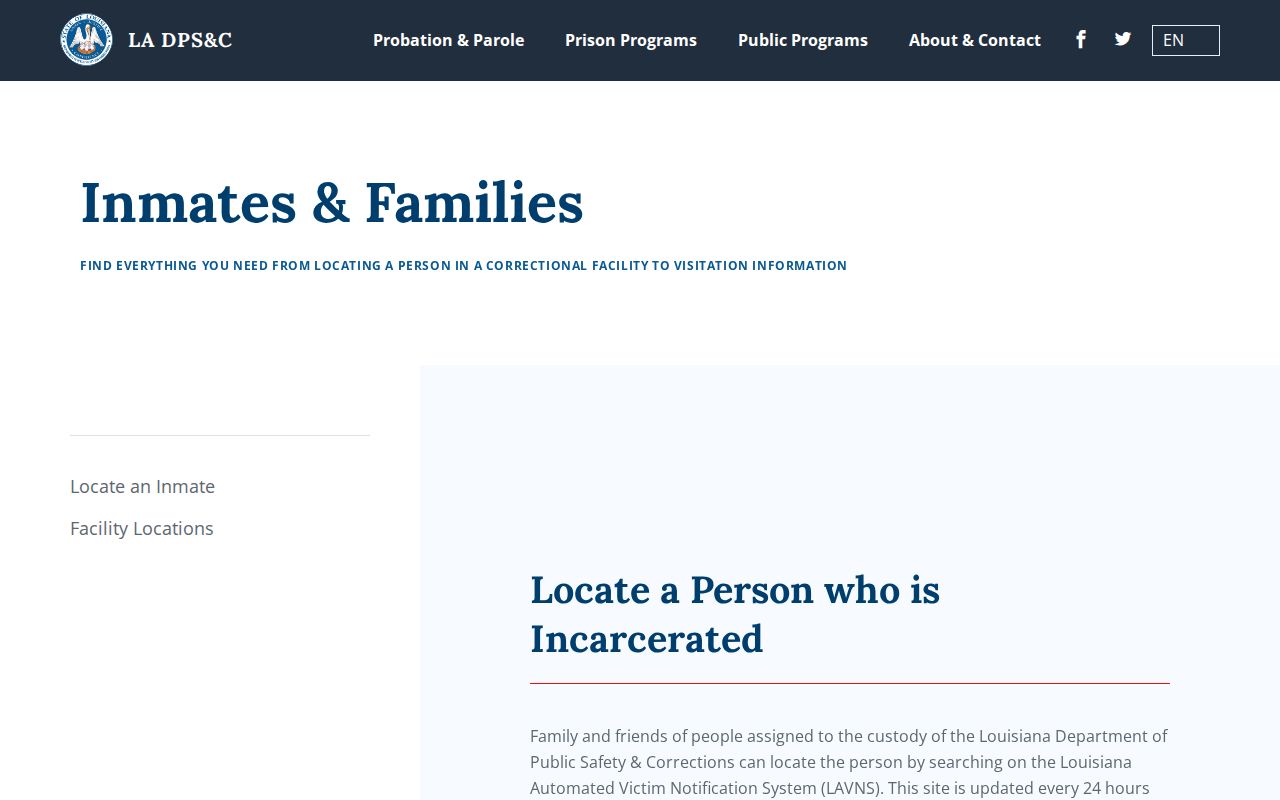
The captured state page supports the phone-based route and should not be read as a promise that every public VINELink result displays a projected date.
Ascension Parish Pretrial Release Timing
A pretrial booking has no fixed sentence end. APSO's Scheduled Release Date field can be blank or provisional, and the absence of a date does not mean indefinite lawful custody. A judge, bond transaction, dismissal, warrant resolution, or another case can change the path. APSO identifies cash, surety, and property bonds posted through its jail-release procedure within the 23rd Judicial District Court system.
Bond release is not case dismissal. It returns an eligible person to the community while the case proceeds, subject to the court's order and any other hold. A “time served” disposition may support release only when no other charge or custodian keeps the person. If the APSO detail says “Transferred other Agency,” the parish booking ended but release to the community did not occur.
Use the docket shown in the booking. The 23rd Judicial District Court handles broad criminal jurisdiction, while qualifying misdemeanors and ordinances may route through Ascension Parish Court. Court minutes explain the legal order. APSO supplies the physical custody record.
Note: A blank scheduled date for a pretrial detainee is not an error by itself because no sentence-based date may exist.
Ascension Parish Good-Time Release Rules
Good time, also called diminution of sentence, is a lawful reduction in time confined when the person and sentence qualify. The offense date matters. R.S. 15:571.3 contains several rules for older offense dates and sentence classes. It should not be compressed into one statewide percentage. Violence classifications, repeat status, exclusions, and other statutory facts can change the calculation.
For crimes committed on or after August 1, 2024, R.S. 15:571.3.1 generally caps ordinary felony good-time diminution at 15 percent for eligible people in parish prison or DPS&C custody. The subsection excludes sex offenses and habitual-offender sentences. It also addresses program credit, time-served credit, forfeiture, and DPS&C authority over earning. Those limits make “about 85 percent” possible only when the full ordinary credit is earned and kept.
The percentage is not a promise. An excluded person may receive none under that provision. Qualifying program credit may affect another case. Jail credit, consecutive terms, later orders, and forfeiture can change the math. Do not subtract a percentage from an oral sentence and report the result as an Ascension Parish inmate release date.
Ascension Parish 85 Percent Release
The newer 15 percent cap produces the familiar “serve roughly 85 percent” concept only in a narrow mathematical sense. It assumes eligibility, full earning, and no later loss. The date must still come from the official calculation. It also describes the end of physical confinement under the applicable diminution framework, not necessarily the end of legal sentence status.
R.S. 15:571.5 treats release by diminution under its rules as release as if on parole and addresses certificates and conditions. The newer framework describes an unsupervised-parole remainder in the ordinary case. Thus, leaving custody after good time can begin a remaining legal period rather than produce full discharge.
Why Ascension Parish Release Dates Change
A projected date is built from records received by the agency. DPS&C notes that a date may remain unavailable until official sentencing papers arrive and staff complete the calculation. Even after a date appears, later entries can move it. Certified treatment or rehabilitation program credits may take time to post, and the Department says such posting can take up to 90 days.
| Factor | Effect on the date |
|---|---|
| Incomplete court paperwork | Prevents or delays a complete calculation |
| Concurrent or consecutive terms | Changes how multiple sentences combine |
| Good-time earning or forfeiture | Moves the physical-release projection under applicable law |
| Program credit posting | Can alter the date after qualifying credit is certified |
| Detainer or warrant | Can lead to continued custody or transfer after one sentence path ends |
| Amended sentence or new case | Changes the legal terms used in the computation |
| Parole action | May create a separate eligibility and release path, subject to final processing |
R.S. 15:571.4 addresses forfeiture tied to disciplinary events. Parole eligibility is separately date-sensitive under Louisiana law. A Committee grant can still require conditions, placement, paperwork, and a later physical release. Eligibility, grant, projection, actual release, and discharge are separate milestones.
Ascension Parish Master Prison Record
The Master Prison Record is the stronger state calculation document. It can reflect the sentence data, credits, and milestones compressed by a public locator. DPS&C uses “WRE” for transitional-work eligibility, which is not the same as the projected release date. The public projected date is officially described through the phone locator, while the complete calculation belongs in the record.
State-facility residents send calculation questions in writing to their facility Records Office. State prisoners housed in a local jail use the Administrative Remedy Process described by DPS&C. The time-computation information line is 225-342-0799. A third party seeking public information must still respect statutory limits, while the incarcerated person receives the Master Prison Record after calculation.
This distinction is vital in Ascension Parish because Louisiana can house state-sentenced people in local jails. APSO may report the physical location and movement. DPS&C controls the state sentence computation. Search both rather than assuming the parish jail owns every date shown for a person held there.
A focused records question should name the calculation being checked. Ask which offense-date law applies, whether the listed terms run at the same time or one after another, which jail credit has posted, and whether a detainer affects physical release. Request the official record or remedy route instead of asking staff to confirm a date calculated from public snippets.
The sentencing papers are part of the chain. DPS&C cannot complete a sound calculation before it receives the controlling judgment and commitment material. If a recent amendment is missing, the court clerk can confirm the official filing while DPS&C explains when it entered the state record.
Note: “WRE” is a transitional-work eligibility marker in the Master Prison Record, not proof of a scheduled or actual release.
Confirm Ascension Parish Actual Release
On the expected date, check the APSO detail or the state custody record again. Look for an actual release event, the exact status, and any receiving agency. Then compare the court or sentence record. A past scheduled date with no confirmed event may reflect a changed calculation, a hold, or delayed processing.
For a state case, LAVNS can show a move from prison custody to community supervision. For a parish booking, the APSO actual timestamp and charge disposition give the local evidence. The Ascension Parish VINELink release check explains how to register for custody-change alerts. Notifications still require source confirmation.
When systems conflict, ask the custodian that owns the disputed event. APSO owns its jail movement. DPS&C owns the state calculation. The sentencing court owns its order. Save the date of the answer and avoid using an old projection as a current claim.
Ascension Parish Jail Records can address the local booking at 225-473-8674, subject to live confirmation of the number's purpose. For an official written jail record, APSO requires a USPS request to its Legal Affairs custodian. Ask for the actual time custody ended and the release or transfer disposition, not merely the scheduled field.
A future state date also needs a final check near the event. Credits can post, be lost, or be recalculated. A new court order or another agency's hold can intervene. Only the later custody entry and disposition show whether the person left confinement, moved elsewhere, or stayed beyond the earlier estimate.
After the event, replace the estimate with the actual record. Note whether the entry says community release, transfer, parole, or another disposition. That final label keeps an Ascension Parish projected release date from being reported as a fact after the custody path changed.