
Ascension Parish 72-Hour Release Window
A three-day window can bridge a weekend, a holiday closure, or a gap between personal checks. It can also catch a booking detail that was not reviewed on the day custody ended. Yet Ascension Parish has no public control that selects all actual releases during that span. APSO New World exposes booking-from and booking-to dates. Those dates track entry into custody, not exit.
The distinction changes the result set. Someone booked before the three-day period and released within it will not be found by limiting booking dates to the latest three days. A new booking that ends in state pickup or another transfer may appear even though the person did not enter the community. The public search can answer a known-person question, but it cannot support a complete bulk claim about everyone released over the weekend.
Check Ascension Parish Three-Day Releases
Begin with a person, arrest, or booking number. The APSO Inmate Search provides name, subject number, booking number, In Custody, booking dates, and housing controls. Its results show identity and custody fields, while the detail can connect the subject to more than one booking episode.
- Define the exact 72-hour interval, including its start and end times.
- Search the person by full name, then retry aliases, separate name parts, subject number, or booking number.
- Use booking dates only to locate likely episodes. Broaden them beyond the interval when the arrest occurred earlier.
- Check Ascension Parish Jail and Off Site Housing, since off-site placement is not release.
- Open the correct booking and capture the actual Release Date and time, not only the scheduled date.
- Read all dispositions, bond rows, court references, and transfer entries before classifying the exit.
For a list meant to be complete, mail APSO a request for nonexempt movement or release records covering that precise interval. Ask for actual exit time, disposition, whether the event was community release or transfer, and the receiving agency when recorded. That request targets the custody event instead of trying to infer it from a booking filter.
Keep an interval log. Note the exact start and end, the time New World was checked, and the booking numbers reviewed. A result can change after court paperwork or jail processing reaches the system. When more than one booking appears, the latest status must not be assigned to every prior episode. Matching the episode is more important than matching a familiar name.
Ascension Parish 72-Hour Release Fields
The public system’s fields are enough to investigate an individual but not to certify that a three-day set is complete. Separate identity, entry, planned exit, actual exit, and legal disposition. Each answers a different question.
| Field | Value in a 72-hour review |
|---|---|
| Name, photo, and subject number | Confirms the record belongs to the intended person |
| Multiple Bookings | Signals that a prior or later episode may carry a different status |
| Booking Date | Shows entry and helps select the episode; it does not show release |
| In Custody | Reports the current APSO indicator when the system was checked |
| Scheduled Release Date | Shows a plan that can change and may remain blank |
| Actual Release Date and time | Shows when APSO custody for that booking ended |
| Charge disposition and bond | Helps explain a community release or unresolved charge |
| Transfer or receiving agency | Shows continued custody under another authority |
A scheduled date that falls inside the period is not proof that release occurred. Court action, a detainer, new charges, credits, discipline, or recalculation can move the date. An actual timestamp is stronger, but a transfer disposition still means the person remained in custody.
The housing field also needs care. “Off Site Housing” is an APSO filter category, not a separately identified public jail and not a community-release code. Search both housing choices when a person seems to vanish from the main-jail filter. If the detail does not name the off-site custodian, ask APSO which agency or facility holds the person.
Ascension Parish Weekend Release Checks
A 72-hour review is most useful as a catch-up process. Start with Friday, weekend, or holiday events that may have been missed, then check each relevant booking after the interval closes. APSO does not publish routine release hours, a weekend release schedule, an exit door, a waiting area, or a guaranteed New World refresh time. Do not infer any of those details from a timestamp in one old record.
When a person is expected to leave on bond, confirm that the bond was posted and that no other hold remains. A court order may authorize release, while physical processing finishes later. Conversely, the jail may record a departure to another custodian. The court event and jail event can occur at different times, so the three-day window should preserve both timestamps.
For an urgent status question, call the jail line at 225-264-6709 or the records and operations number listed in the official parish directory at 225-473-8674. Ask which office owns the specific record. A phone confirmation should identify the agency and time checked.
Note: APSO publishes no promised delay, so a record checked after the interval is safer than assuming every weekend event appeared at once.
Ascension Parish Release History Quirk
Ascension Parish’s best recent-release feature is also its key limit. New World can retain historical subject pages with actual release times, more than one booking, bonds, and charge dispositions. This makes a known-person search unusually useful after the active roster changes. It does not expose a release-date filter, and APSO gives no fixed term for how long an old detail remains public.
An official historical APSO example shows the form of detail that must be read.
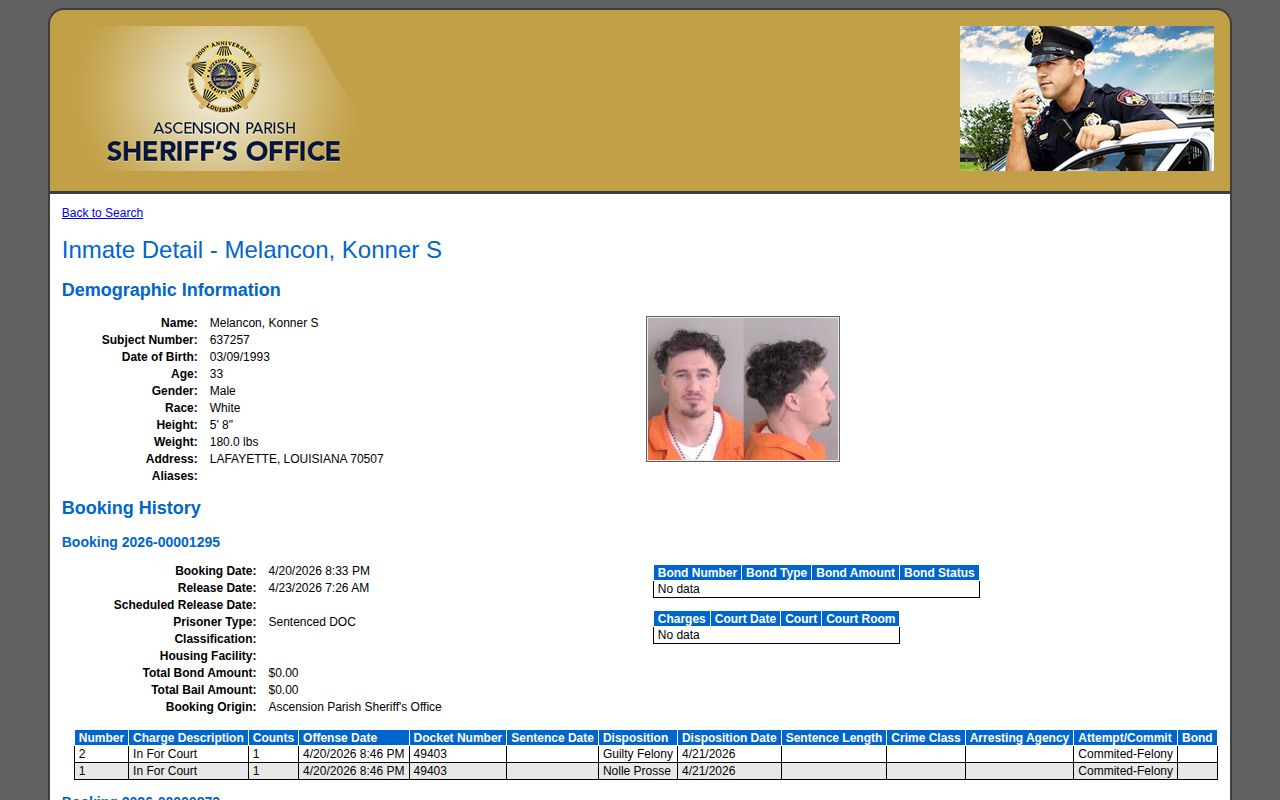
The screen illustrates why actual release timing, the custody indicator, and the disposition must stay connected when reviewing a three-day interval.
A missing result also has several possible causes. The name may be misspelled, the booking may use an alias, a different agency may have handled the arrest, the record may have migrated, or public access may be limited by an expungement. Absence cannot carry the full weight of a release claim.
Request Ascension Parish 72-Hour Records
The APSO public-record instructions require requests to be written and sent by USPS. Mail the request to Ascension Parish Sheriff’s Office Headquarters, 828 South Irma Boulevard, Gonzales, LA 70737, Attn: Deputy Kyle Gautreau, Legal Affairs. The sheriff states that a request sent another way is not deemed received. Keep the request narrow and list the exact date-time boundaries.
Ask for the nonexempt jail movement and release lines for the interval. Request actual date and time physical custody ended, release or disposition code, community-release or transfer marker, and receiving agency. Ask for separable public portions when some fields are protected. Juvenile identities, protected victim data, active investigative material, security facts, and other exempt content may be withheld or redacted.
APSO posts $1 per document page, $5 per photograph page, and $1 per audio or video minute plus $10 per disc. After a decision to release a record, APSO issues an invoice and requires payment before production. These amounts do not predict the total for a three-day extract.
The public-record response framework does not promise instant production. R.S. 44:35 addresses a written decision or a reasonable-time estimate after five days excluding weekends and legal holidays. It does not require every responsive record to be delivered within five business days.
Booking sheets may be available in person at APSO’s named offices, but that option is not the same as a prepared three-day release extract. A mailed request should be used when the scope covers a whole interval or calls for movement details beyond a basic booking sheet. Narrow terms make the desired event clear and reduce the risk of receiving entry records that do not answer the release question.
Verify Ascension Parish Release Destinations
A three-day exit review is complete only when the destination is known. A community release may follow bond, recognizance, time served, sentence completion, or another court order. Off Site Housing is an APSO housing category, not proof of release. A move to Louisiana DPS&C, another parish, BOP, the U.S. Marshals Service, or ICE means custody continued.
Louisiana LAVNS and VINELink cover adult custody status in parish jails and state prisons. DPS&C also says its statewide data updates every 24 hours and can cover people under probation or parole supervision. That state cadence does not apply to APSO New World. BOP and ICE require separate federal searches.
For one named person whose history crosses agencies, the Ascension Parish released inmate search explains the full local, court, state, and federal chain. For the latest same-day period, the Released Last 24 Hours workflow narrows the timing but uses the same careful distinction between a jail exit and freedom.
Document the source and time of each result. “APSO detail reported an actual exit,” “court minute authorized bond,” or “DPS&C reported community supervision” is clearer than an unsupported statement that someone was simply released. A later arrest can also make an older status stale.