
Federal Prison Release Scope
No BOP institution was identified inside Ascension Parish in the official sources reviewed. A federal case can still involve an Ascension arrest, federal prosecution, contract placement, or transfer. Search follows the federal custodian, not the parish line. APSO may record that a local booking ended when a federal agency took custody, but that is a handoff rather than community release.
The BOP Inmate Locator covers federal inmate records from 1982 to the present. It is strongest for people who entered the sentenced federal prison system. A person held pretrial by the U.S. Marshals Service can stay in a local or contract facility and move without becoming a sentenced BOP prisoner. Federal court minutes or the responsible USMS contact may be needed for that path.
Search Federal Prison Release Records
The BOP Inmate Locator supports a register-number search and a name search. A federal identifier is the most precise path. When only a name is available, match the returned age, race, sex, register number, release date, and location before relying on the record.
- Choose the federal number search when a BOP register number or another supported number is known.
- Otherwise enter the legal first and last name and any available middle name.
- Use age, race, and sex only as matching details, not as the sole identity proof.
- Open or read the result with its register number, date, and location.
- Distinguish a future projected date from a past release date.
- Record the exact terms “Released,” “Not in BOP Custody,” “Unknown,” or the displayed institution.
Save the search date. First Step Act recalculations and other sentence changes can move a future date. A current institution establishes BOP placement at the time reported, while an old record cannot resolve a later arrest or custody event under another government.
Search variations matter. A federal record may use a legal name, middle initial, suffix, or spelling that differs from an Ascension booking. A register number avoids much of that ambiguity. When only a name is available, compare every returned identifier and do not combine two people merely because they share a name.
Federal Prison Release Status Meanings
BOP explains its result labels in a specific way. A future release date is projected. A past release date with no listed facility indicates that release occurred on that date and the person is no longer in BOP custody. “Released” also means BOP no longer holds the person. These labels do not erase any term of supervised release or rule out custody elsewhere.
| BOP field or label | Safe interpretation |
|---|---|
| Future release date | A projection that may change before physical release |
| Past release date, no facility | BOP reports release on that date and no current BOP custody |
| Released | The person is no longer held by BOP |
| Not in BOP Custody | BOP does not currently hold the person; another status may follow |
| Unknown | The federal term or date is not determined in the locator |
| Community-confinement location | The person can remain in BOP custody outside a prison institution |
A location entry must be read as displayed. Community confinement can include a non-prison setting while BOP custody continues. A transfer field does not prove release. When the public result seems inconsistent with the federal docket, confirm with the agency that owns the disputed event.
A past date has a different role from a future date. It can establish BOP’s reported end of custody when no facility remains. It cannot show whether the person began supervised release, entered another government’s custody, or later faced a new federal case.
BOP Release Record Explanation
The official BOP records explanation defines the locator’s dates and status limits.
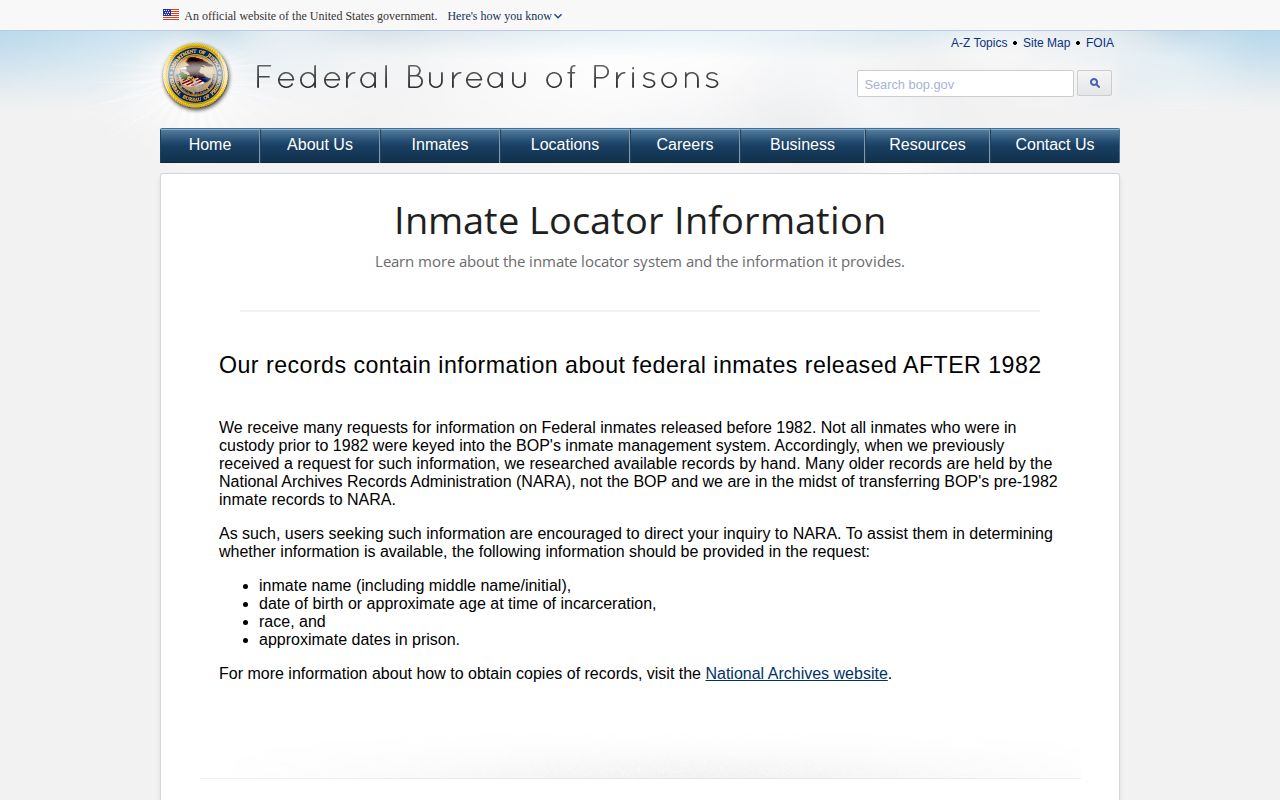
The official explanation helps separate a projected date from a completed federal release and prevents “Not in BOP Custody” from being overstated as freedom from every authority.
BOP records from before 1982 are not covered by the locator’s stated online range. The locator is also not a universal federal arrest database. A federal prosecution that never led to a BOP sentence belongs in the federal court record and, where applicable, the USMS custody path.
Ascension Federal Release Handoffs
An APSO booking inquiry can show the actual time Ascension Parish custody ended and may identify a receiving agency. If that agency is federal, the local timestamp marks the parish handoff. It does not establish a federal release date. Search BOP for a sentenced person, then check the federal docket when the person was pretrial or the locator does not explain the movement.
A USMS detainee may be held at a contract or local facility. Movement between those locations can occur without a public BOP institution result. The federal court minute can show detention, bond, sentence, or release orders. A court order is the legal event; the custodian’s record is the physical-custody event.
The Ascension Parish release search provides the local booking and court side of this chain. Use no more of the APSO record than needed to identify the federal handoff, then let the BOP or federal court source answer the later status.
Federal Prison Release Record Sources
No single source answers every federal release question. The locator reports public BOP fields. The federal court docket explains prosecution, bond, sentence, and supervised-release orders. BOP institutional records may contain the formal custody and release material. USMS controls its own pretrial and transport events.
- Projected release
- A future BOP date that can change after recalculation.
- Supervised release
- A federal court-ordered community term that follows imprisonment in many cases.
- Community confinement
- A non-prison placement that may remain within BOP custody.
- USMS custody
- Federal marshal detention or transport, often before sentencing or BOP designation.
For a durable record, preserve the register number, search date, exact locator label, and the court case number. Do not infer the end of supervised release from the end of BOP custody. A later state, local, or immigration hold can also change where the person went next.
The sentencing judgment and later federal orders define supervised release. A violation can return a person to court and sometimes custody after the first prison term ends. The locator’s old release entry may remain accurate for that earlier episode without describing the newest federal status.
Federal Versus State Release Search
Federal and Louisiana searches are separate. BOP covers federal imprisonment. Louisiana LAVNS and DPS&C cover state prisons and state supervision. APSO covers the Ascension Parish booking. ICE ODLS covers certain current immigration custody. A name may appear in more than one system at different times.
Use the case and receiving-agency notation to choose the next source. An APSO transfer to state corrections belongs in DPS&C, not BOP. A BOP “Released” record does not prove the person entered Louisiana supervision. An ICE handoff is not resolved by either criminal-custody locator.
A federal case can also end without a BOP sentence. Bond, dismissal, acquittal, probation, or time already served may leave no sentenced-prison result to interpret. The docket and USMS information are then more useful than repeated searches of a locator that is not a complete federal case index.
Note: Record each agency’s label and query time so a past federal release is not confused with a newer local or state custody event.
Ascension Jail Federal Context
APSO reports that the Ascension Parish Jail has operated since 1976. Its 2022 report described an average above 400 incarcerated people and more than 70 corrections officers, and the current page describes capacity above 500 beds. These are jail context figures, not counts of federal prisoners or federal releases.
No BOP prison was identified in Ascension Parish. The local jail’s age and scale do not make it part of the BOP institution system. At most, a federal agency can appear as a receiving custodian or a federal detainee can move through a contract arrangement. The named agency and court case must support that classification.
Where does a BOP-released person go? The locator can establish departure from BOP, but the federal court record may show supervised release. Another sovereign’s custody must be checked separately.